I had heard about the small produce market each week on the island when Mennonites from northern Belize would come down to sell fruit, vegetables and meat. Being used to amazing farmers markets back home, especially when living in Wisconsin’s Amish country, I knew what the Mennonites brought down to us would be better than the soggy, sometimes half-rotten produce I kept finding in these grocery stores.
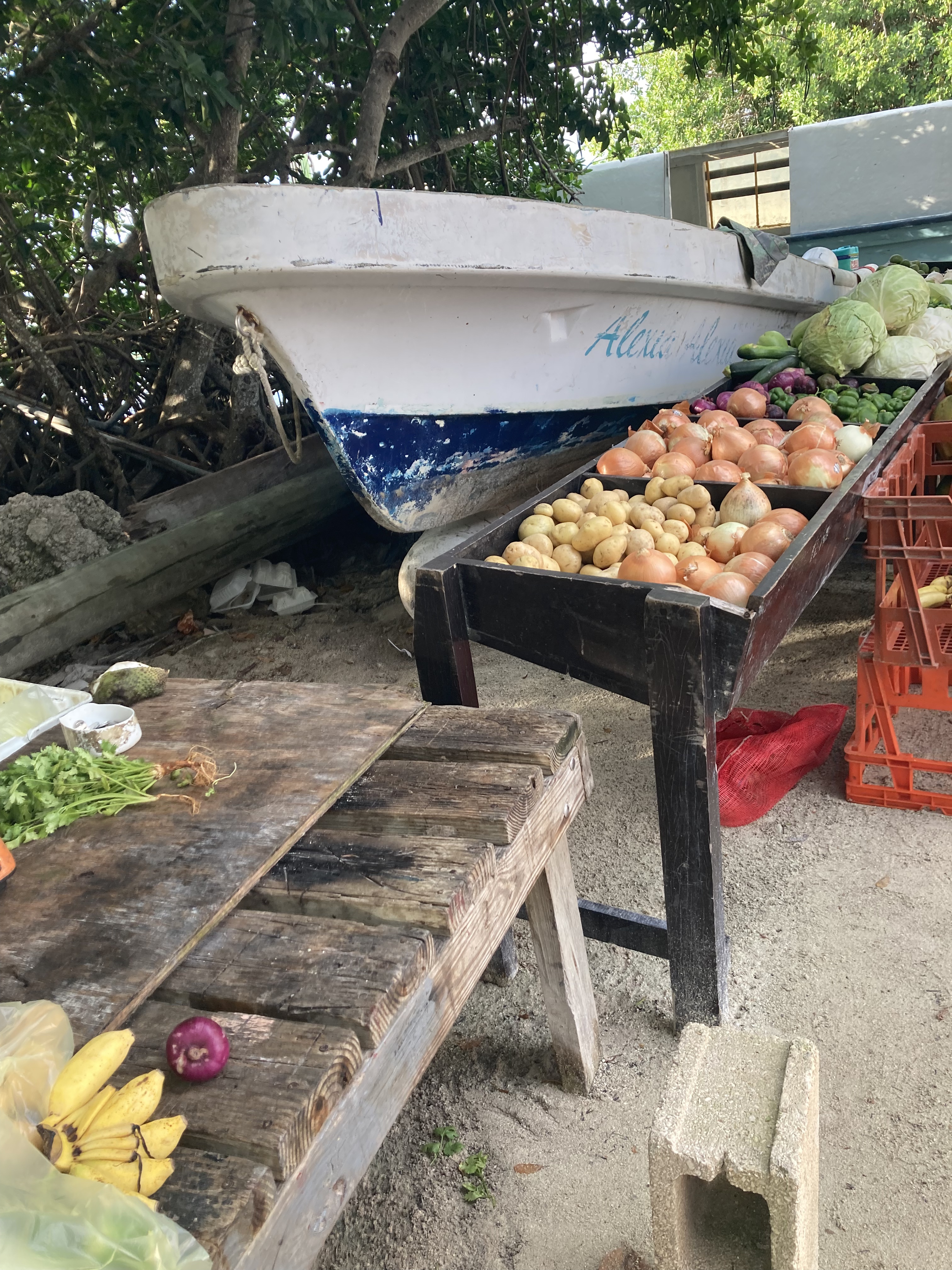
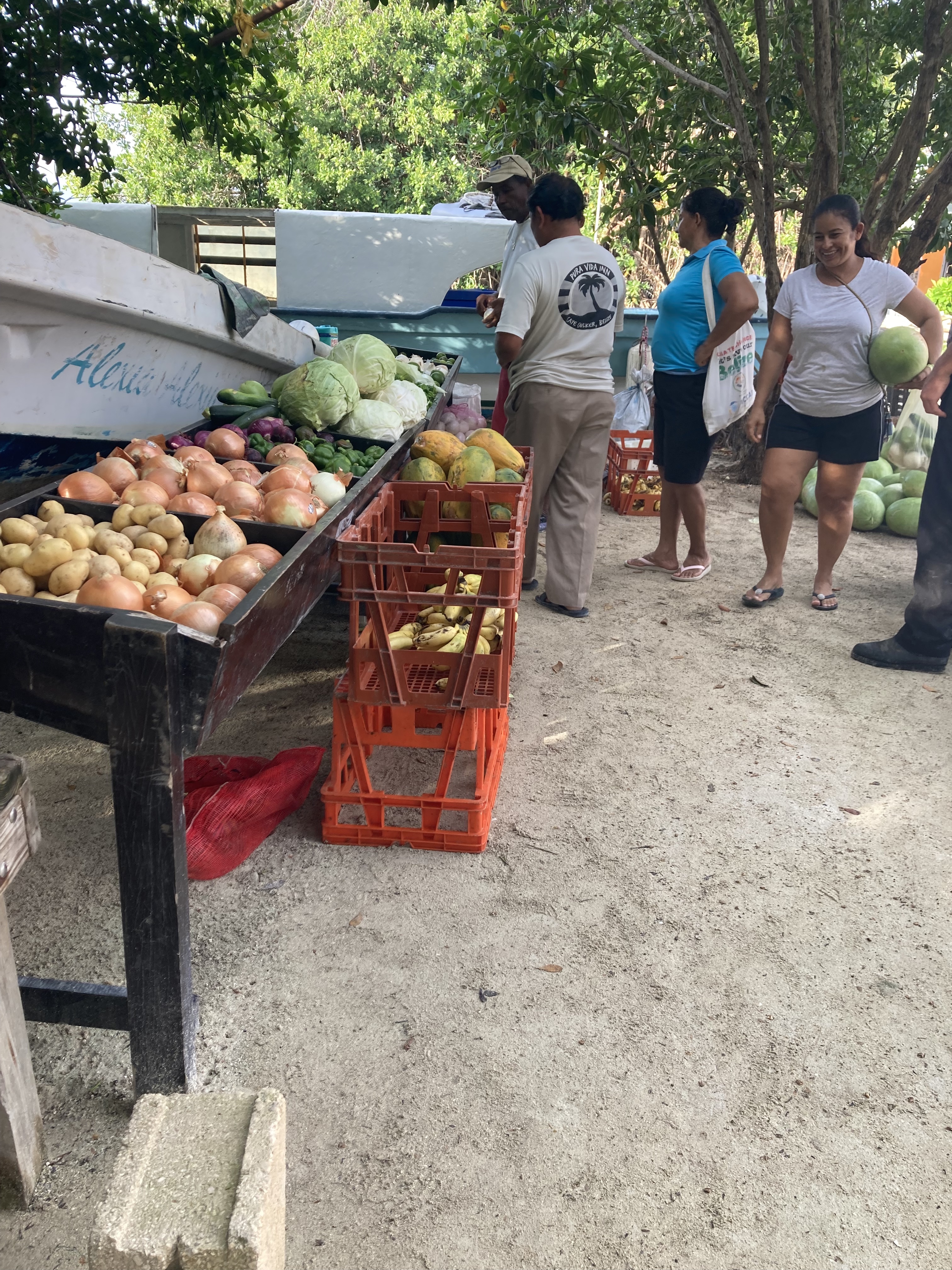
After spending a few minutes on a small beach petting (yes you can pet them!) a gathering of huge stingrays – who know they get fed small fish there every day at 4:30 – I headed south to try and find this hidden market. Down a very narrow bumpy dirt road that follows the water along the west coast, I saw a small boat on its side. In front of the boat was a table of produce, and on the ground the biggest watermelons I’ve ever seen. Right before I came here I learned that seedless watermelons are round and those with seeds are the bigger, oval-shaped ones. There isn’t any genetically modified or hybrid fruit in Belize, so all watermelons have seeds and so do the red grapes.
There was a large, older Mennonite man at the table, taking money and a couple of younger ones moving about with customers. These Mennonites look somewhat similar to my Amish friends back home: long pants, button down collared sleeves on men (except Amish don’t use buttons), and thin fabric suspenders. The community is more progressive than the conservative Amish I’m used to but this is not at all what struck me as odd. While the Amish communities back home speak perfect English with a slight Germanic accent of sorts, they also speak some version of a Pennsylvania Dutch (or Amish Dutch) dialect. That’s what I’m used to. What completely broke my brain and then some was the fact that as a young Mennonite man walked past me he was speaking Belizean Creole (Kriol) to a customer, and the older Mennonite man at the table was speaking rather perfect Spanish to another customer! This was a wild type of sensory overload for my brains. I knew there were two Mennonite settlements in Belize but I assumed they spoke English and maybe some sort of Amish Dutch, a Germanic language. I never in a million years thought I’d hear them speak Creole or Spanish. I guess that’s very close minded of me and illustrates the huge point that we have to travel places other than our own and experience as many different cultures as we can.
Once the shock wore off and I saw how beautiful the produce was I again assumed that since I could not speak Creole yet that my Spanglish-Spanish was going to have to be our form of communication. I gathered an arm full of produce and when I couldn’t hold anymore but wanted to keep shopping, I went toward the older gentleman and put my items down. In really bad Spanish I tried to convey that I wasn’t done and needed a bit more time to gather more, “un momentito, por favor.” He asked me something in Spanish to which I responded in kind. As surprised as I was to hear him speaking Spanish, his widened eyes and shocked expression gave me indication that he couldn’t believe I spoke Spanish either. It was such a funny moment of two people assuming they understood enough about each other’s nationality and culture, but clearly missing some key pieces. I switched to English on the off chance he could also speak it, and was relieved to hear that he could do the same. Whew.
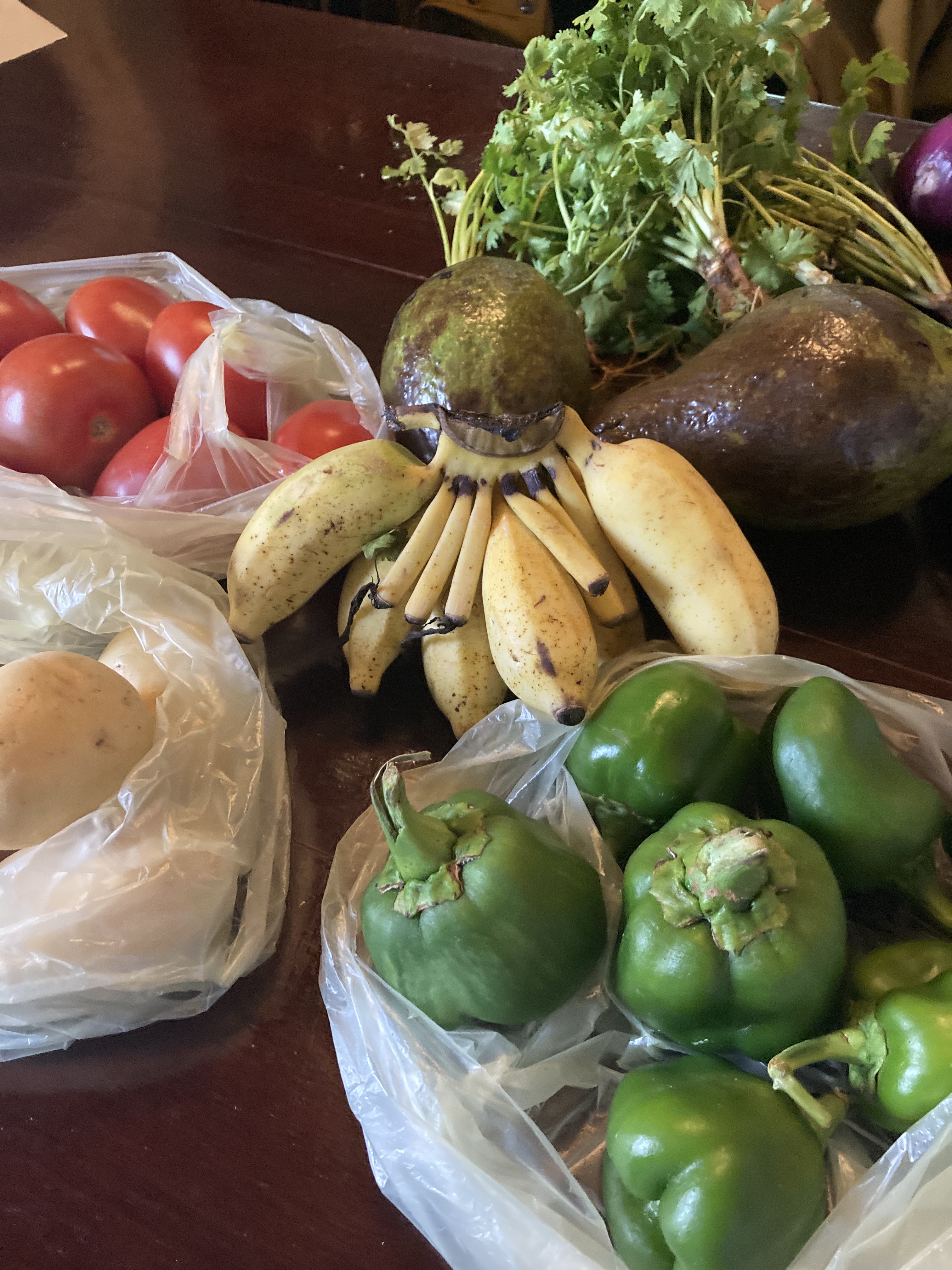
For almost half of what the Chinese-owned grocery stores on this island charge, I got a full bag of garden fresh produce. (All grocery stores, many of the resorts and some of the restaurants on this island are owned by Chinese immigrants. Apparently my people – the Lebanese immigrants – have cornered the hardware store market, in Belize). For $15 BZD – $7.50 USD – I was able to buy some baby potatoes, eight big Roma tomatoes, three cucumbers, eight tiny green bell peppers, two big avocados, a bunch of tropical baby bananas and some cilantro.
Before returning home I went to the butcher shop and bought a tiny steak to go with the potatoes for the following day. Then I headed home with my haul, cleaned it in purified soapy water and made some guacamole with a few of the ingredients. I was curious to try those baby bananas because they’re one of my friend’s favorites. She became addicted to them during her time in Vietnam. Their yellow skin with brown spots indicated to me, and maybe only to me, that those bananas were ripe enough. I’ve lived on this planet for 47 years and when I see a yellow banana with brown spots that has always been an indication of a sweet banana. Usually too sweet for me, in fact, as I prefer them yellow with no brown spots. But we all know there’s that fine line between mildly sweet and edible, and, “Oh crap, it’s still too green and chalky inside.” This little baby-sized banana, called “blogo” here, was so dry and chalky on the inside I wondered if I could even swallow the bite I took without choking. There was something so weird in the texture that it felt like the blogo was drying the inside of my mouth out the longer I chewed it. Determined to not waste this beautiful produce I just bought but also not wanting to die eating a stupid miniature piece of fruit, I gagged that bite down and threw the other half away. I would rather die doing something really fun and amazing (preferably at the age of 90), than in middle age on a tropical island in my apartment with a piece of banana in my mouth.


 Pixie in Paradise
Leave a comment